ChronoSpeak
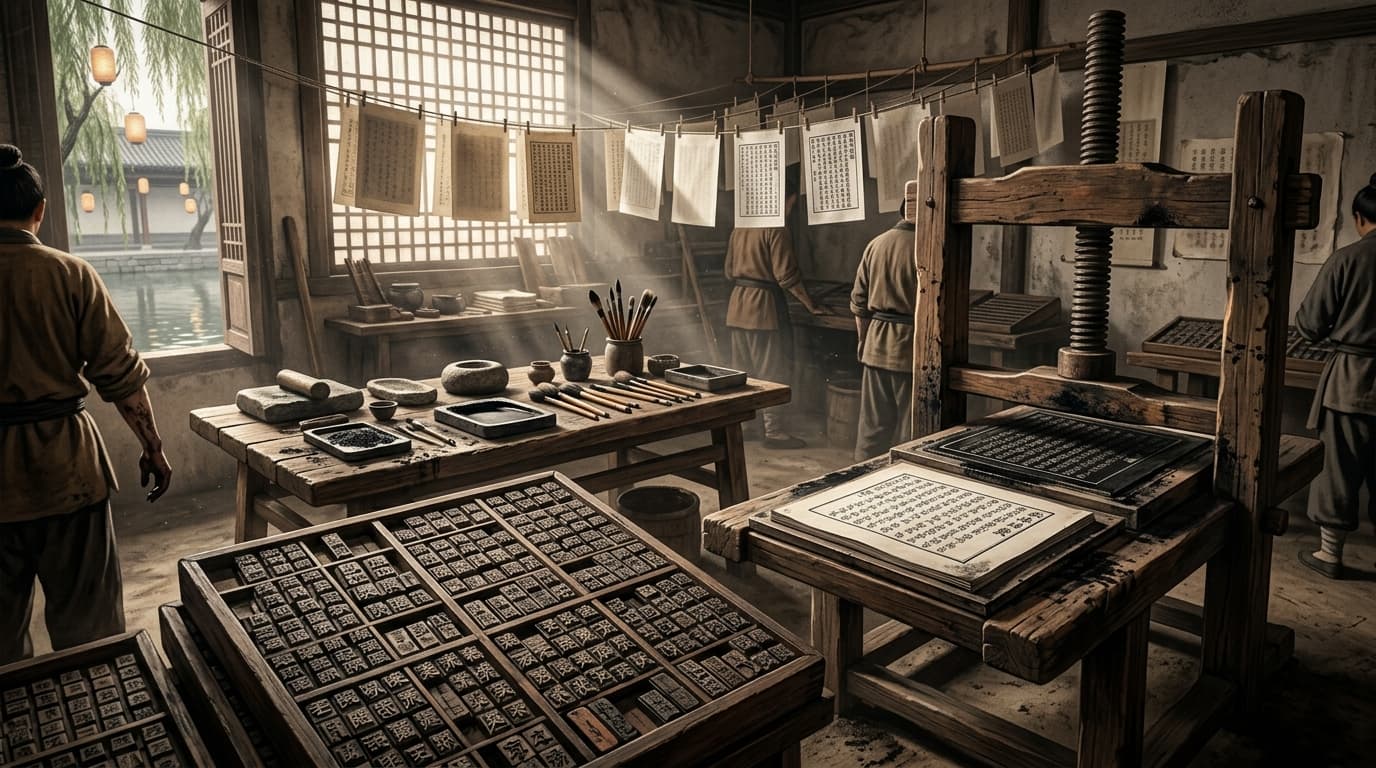
A Song printing workshop with trays of clay movable type and a wooden press under warm lamplight.
Song Dynasty960–1279 CEIntermediatePro中文PinyinHSK 3.0

The Printing Workshop

书坊Shū Fāng

Watch movable type being invented, one clay character at a time.

The scene

A workshop that smells of ink, pine soot and wet clay. On the bench is a tray of hundreds of small fired characters, each one a single word, and a man who has just worked out how to set them fast enough to matter.

What you will be able to do

  • Describe a process step by step
  • Use measure words for objects in a workshop
  • Ask how something works and follow a technical explanation

Who you will be talking to

1 character

毕昇

Bì Shēng

Printer, inventor of movable type · in his fifties

A commoner craftsman in a trade dominated by woodblock workshops. He has spent years cutting individual characters out of clay, firing them hard, and setting them into an iron frame — and he can now print a page that would have taken a carver a month.

methodicalinventivebluntdelighted by unsolved problems

别碰那盘字——墨还没干。你是来学徒的,还是来买书的?

Bié pèng nà pán zì — mò hái méi gān. Nǐ shì lái xuétú de, háishì lái mǎi shū de?

Don't touch that tray of type — the ink isn't dry. Are you here to apprentice, or to buy a book?

Words you will use

8 · Pinyin and HSK 3.0
  • 印刷yìn shuā
    printingnounHSK 4
  • 活字huó zì
    movable typenounHSK 5

    Literally: living + character

    A beautiful coinage: type that can be rearranged is 'living' type, as opposed to a carved dead block.

  • 墨mò
    inknounHSK 3
  • 纸zhǐ
    papernounHSK 2
  • 书shū
    booknounHSK 1
  • 刻kè
    to carve; to cutverbHSK 4
  • 泥ní
    clay; mudnounHSK 3
  • 工人gōng rén
    worker; craftsmannounHSK 3

What is going on here

3 culture notes
HistorySurprising

We know about him from one paragraph

Bi Sheng left no book of his own. Everything we know comes from a single passage in 梦溪笔谈, the Dream Pool Essays, written by Shen Kuo around 1088 — a description of clay type, an iron frame, and a pine-resin binder.

History

Why clay, and not wood

Wood grain makes a carved character uneven, and wood swells with ink. Fired clay holds a sharp edge and does not warp. Bi Sheng's choice was not primitive — it was correct, and it stayed correct for centuries.

Daily life

Cheap books, more readers

Song printing houses turned out books at a volume no earlier dynasty could match. Printing did not create mass literacy by itself, but it made the price of a book something a merchant's son could plausibly meet.

The scripted path

1 authored dialogue

One Character at a Time

Follow Bi Sheng through the whole process — clay, fire, iron frame, pine resin — and learn the sentences that keep up with a man explaining his work.

11 turns · ~18 min

  1. Them

    站在门口干什么?过来。这盘字是我刻的,墨还没干。

    Zhàn zài ménkǒu gàn shénme? Guòlái. Zhè pán zì shì wǒ kè de, mò hái méi gān.

    What are you doing standing in the doorway? Come here. This tray of type is what I cut — the ink isn't dry yet.

  2. You

    这些字怎么用?它们能印成一本书吗?

    Zhèxiē zì zěnme yòng? Tāmen néng yìn chéng yì běn shū ma?

    How do you use these characters? Can they print a whole book?

  3. Them

    先拿泥,切成小块,在每块上刻一个字。刻好了,把它送进火里,烤得很硬。

    Xiān ná ní, qiē chéng xiǎo kuài, zài měi kuài shàng kè yí ge zì. Kè hǎo le, bǎ tā sòng jìn huǒ lǐ, kǎo de hěn yìng.

    First you take clay, cut it into small pieces, and carve one character on each piece. When they're carved, you put them into the fire and fire them until they're very hard.

  4. You

    为什么不用木头?木头不是更便宜吗?

    Wèi shénme bú yòng mùtou? Mùtou bú shì gèng piányi ma?

    Why not use wood? Isn't wood cheaper?

  5. 7 more turns, with grammar notes attached to the line where each one matters.