ChronoSpeak
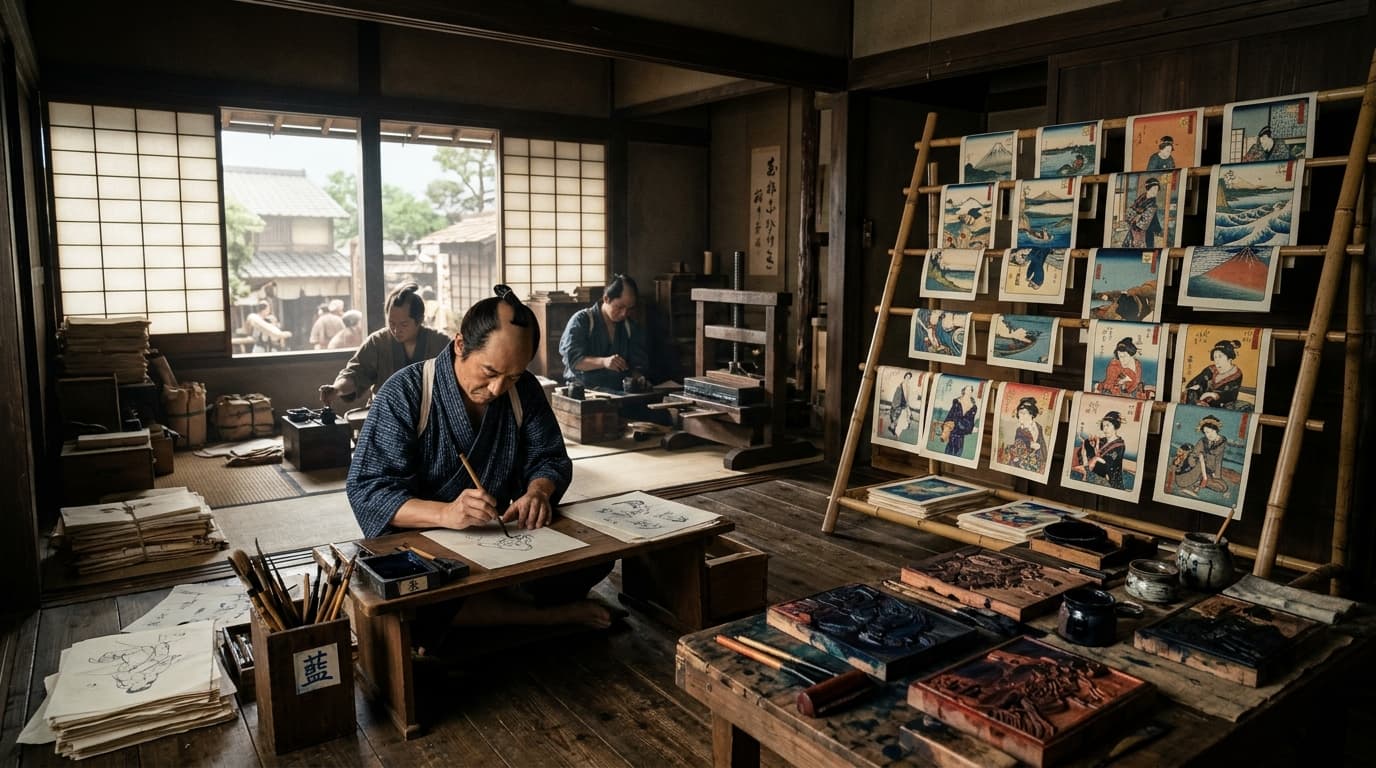
An Edo-period print studio, carved woodblocks and drying prints on a rack, an artist bent over a drawing.
Edo Period1603–1868 CEAdvancedPro日本語RomajiJLPT

The Floating World Studio

浮世絵の工房Ukiyo-e no kōbō

Commission a print, argue about colour, and learn what a sheet is actually worth.

The scene

A print is not one artist's work. The painter draws, the carver cuts the blocks, the printer rubs the colours, and the publisher counts the sheets. Moronobu's studio smells of ink, damp paper and indigo, and everyone has an opinion about the last print.

What you will be able to do

  • Describe colours and materials
  • Talk about how a print is made
  • Make a request with a reason attached
  • Compare quality and value

Who you will be talking to

1 character
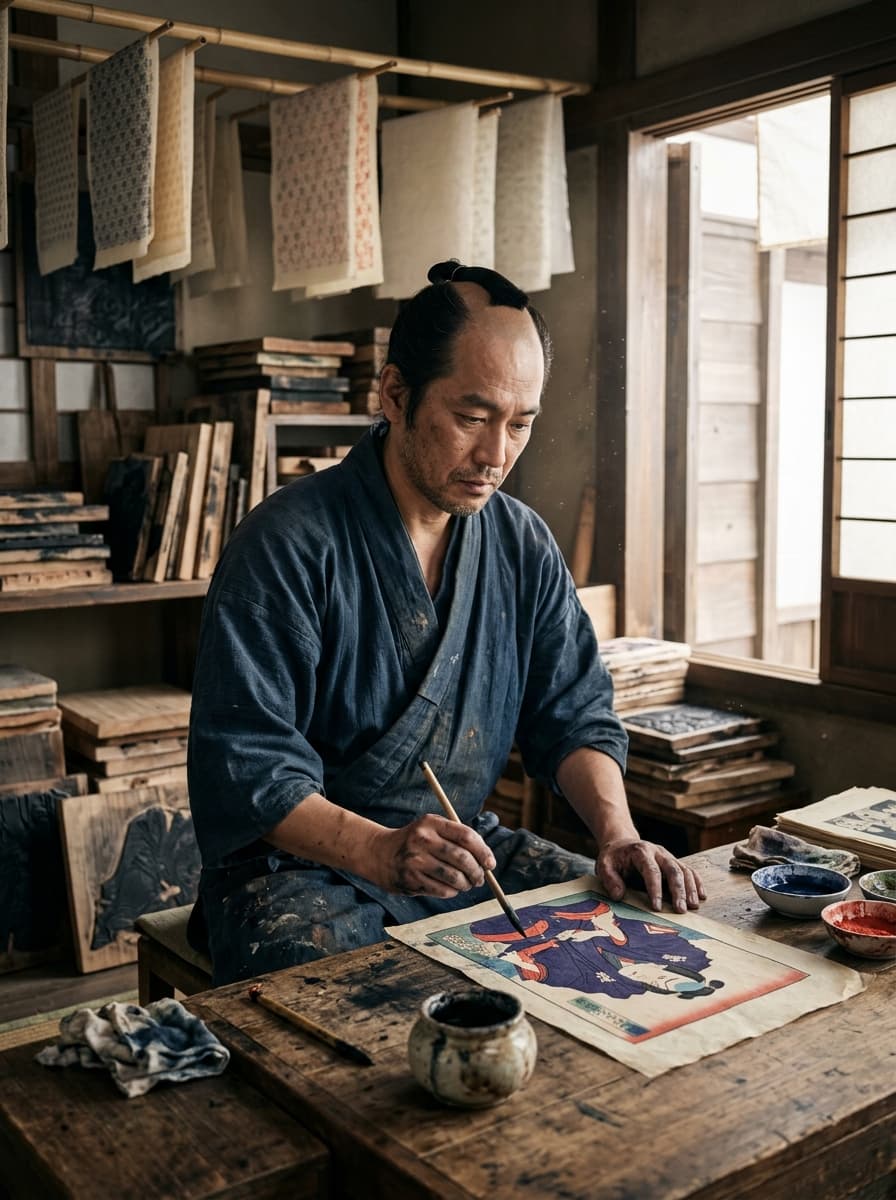
Portrait of Hishikawa Moronobu in an ink-stained work robe, holding a brush over a half-finished print.

菱川師宣

Hishikawa Moronobu

Ukiyo-e artist and printmaker · in his forties

Moronobu made single-sheet prints into something a publisher could sell and a household could afford. He draws quickly, argues about line and colour, and knows exactly how many sheets a block will yield before it cracks. He is proud of his work and not sentimental about it.

observantproudbusinesslikemischievous

その色は、藍だ。刷ると、もっと深くなる。

Sono iro wa, ai da. Suru to, motto fukaku naru.

That colour is indigo. When it is printed, it goes deeper.

Words you will use

9 · Romaji and JLPT
  • 浮世絵
    ukiyo-e
    ukiyo-e; pictures of the floating worldnounN2

    Literally: floating world + picture

  • 版画
    hanga
    woodblock printnounN2
  • 色
    iro
    colournounN3
  • 藍
    ai
    indigonounN2

    The deep blue of aizuri-e prints, made from fermented indigo leaves. It fades beautifully and stains everything.

  • 彫る
    horu
    to carveverbN2

    The carver cuts away everything that will not print. 彫ります — I carve / he carves.

  • 摺る
    suru
    to print by rubbingverbN1

    Not する 'to do' — this 摺る is the printer's verb, rubbing paper onto an inked block.

  • 注文
    chūmon
    order; requestnounN2

    注文する is to place an order. In a studio it means the publisher has commissioned a design.

  • 値打ち
    neuchi
    value; worthnounN1

    What a thing is worth, as opposed to what it costs. A print can be cheap and still have 値打ち.

  • 美しい
    utsukushii
    beautifuli-adjectiveN3

What is going on here

3 culture notes
Trade

Four hands, one print

Ukiyo-e was a commercial collaboration. The artist supplied a brush drawing, the carver cut a key block and one block per colour, the printer aligned the sheets, and the publisher paid all three and sold the edition. A print's credit usually went to the artist and publisher alone.

History

The blue that sold

Aizuri-e — prints made almost entirely in indigo — became a fashion in the 1820s. The pigment was cheap and lightfast compared with many mineral colours, and a single deep blue could carry a whole composition.

History

The man who made the genre a business

Hishikawa Moronobu was not the first ukiyo-e artist, but he was among the first to sign and sell single-sheet prints as a product rather than an illustration in a book. His studio turned a courtly amusement into a market.

The scripted path

1 authored dialogue

The Print That Sells

Commission a print from Moronobu, argue about colour, and learn why a beautiful picture is not necessarily a valuable one.

19 turns · ~20 min

  1. Them

    その色は、藍だ。刷ると、もっと深くなる。

    Sono iro wa, ai da. Suru to, motto fukaku naru.

    That colour is indigo. When it is printed, it becomes deeper.

  2. You

    この青は、とても美しいですね。

    Kono ao wa, totemo utsukushii desu ne.

    This blue is very beautiful.

  3. Them

    美しいだけでは売れない。だが、美しくなければ買わない。

    Utsukushii dake de wa urenai. Da ga, utsukushikunakereba kawanai.

    Beauty alone does not sell. But if it is not beautiful, no one buys it.

  4. You

    値打ちは、どこで決まるのですか。

    Neuchi wa, doko de kimaru no desu ka.

    Where is the value decided?

  5. 15 more turns, with grammar notes attached to the line where each one matters.